
Marble Race – six marbles, twelve seconds, one decision
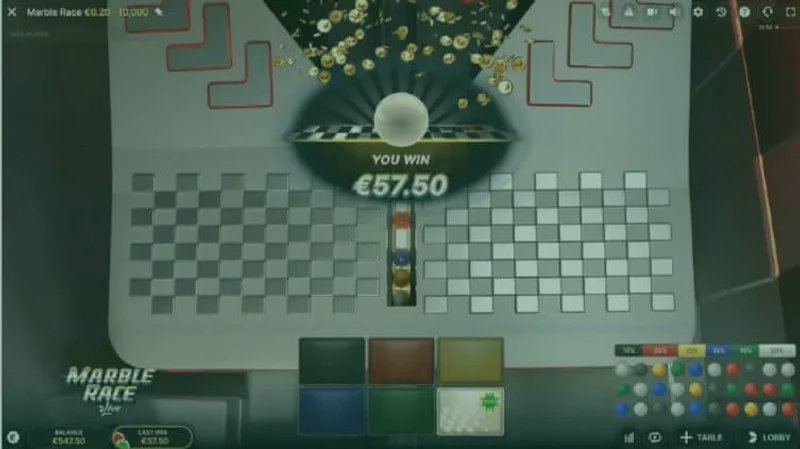
Marble Race is one of the newer Live Game Shows from Evolution Gaming and works completely differently from most casino games. Six heavy balls (billiard type, not glass) roll over a physical track with obstacles on two levels. A host comments live, the starting positions change randomly, and the result depends on real physics – no RNG, no algorithm.
What sets Marble Race apart from other live shows: the betting phase lasts only 12 seconds. The decision must be made within this time. Two options, clear odds, short rounds. Those who approach it in a structured way can control their budget much better than with games that have many side bets.
Two Betting Options in Marble Race – a Mathematical Comparison
Marble Race offers exactly two bet types. No side bets, no bonus rounds, no hidden extras. This makes the calculation simple:
| Bet Type | Odds | RTP | Probability of Winning | EV per 10 EUR Stake |
|---|---|---|---|---|
| 1st Place | 5:1 | 95.83% | 1 out of 6 (16.67%) | -0.42 EUR |
| 1st & 2nd Place | 27:1 | 93.33% | 1 out of 30 (3.33%) | -0.67 EUR |
The 1st Place bet statistically results in 4.2 cents less loss per euro staked than the combo bet. Over 100 rounds, that adds up: with a constant 5 EUR stake, you pay about 21 EUR to the house on 1st Place, about 33 EUR on 1st & 2nd Place. The 2.5 percentage points difference in RTP seems small but matters over longer sessions.
Those speculating on high payouts will find the 27:1 odds appealing. Those who want to protect their budget stick to 5:1.
Using the 12-Second Decision Phase Correctly
Twelve seconds sounds tight but is enough if you know beforehand what you want to do. The problem: many players decide impulsively because the clock is ticking. This leads to errors.
A few rules that help:
- Decide before the game which bet type you will play for the next 10 rounds. Don’t rethink every round.
- Use the 12 seconds only for placing bets, not for pondering. The decision is made beforehand.
- If uncertainty arises: skip the round. There is no obligation to join every round.
- No increasing the stake after lost rounds. The next round doesn’t “know” the previous one.
The betting phase creates slight time pressure, which prompts action. Recognizing this helps make better decisions.

In-Game Statistics in Marble Race – What They Help With and What They Don’t
Marble Race shows the results of past races. Which ball won, which combinations appeared. This tempts players to look for patterns.
Here it gets tricky, to be honest. The balls start each race in a random position. The physical track with its obstacles creates chaotic runs. No race repeats exactly. The statistics show the past, not the future.
Still, the data is not completely useless:
- They help assess distribution. If over 50 rounds each color was roughly equally often in front, this confirms the randomness.
- They make transparent that there is no “hot” or “cold” ball.
- They can signal that one is playing too long (if you start seeing patterns in the numbers that aren’t there).
In short: The statistics are useful for self-control, not for prediction.
Bankroll Management for Fixed-Odds Games
Marble Race has fixed odds and no volatility fluctuations like slots. This makes budget planning easier than with most casino games.
An example calculation with the 1st Place bet (RTP 95.83%):
| Starting Budget | Stake per Round | Expected Rounds until Budget is Exhausted | Session Duration (approx.) |
|---|---|---|---|
| 50 EUR | 1 EUR | ~1,200 | ~10 hours |
| 50 EUR | 5 EUR | ~240 | ~2 hours |
| 100 EUR | 2 EUR | ~1,200 | ~10 hours |
| 100 EUR | 10 EUR | ~240 | ~2 hours |
These numbers are statistical averages. In practice, the budget fluctuates up and down. But they give a realistic idea of how long a session can last.
Three rules for session planning:
- Stake a maximum of 2% of the budget per round. So with 100 EUR, no more than 2 EUR.
- Set a time limit before the first round starts. 30 minutes, 60 minutes, done.
- Profit limit is just as important as loss limit. Stop when 30% profit is reached.
Marble Race vs. Roulette – Two Live Games with Fixed Odds
Both games run live, have fixed payout odds, and are based on physical randomness. Differences in detail:
| Feature | Marble Race | European Roulette |
|---|---|---|
| RTP | 93.33 – 95.83% | 97.30% |
| Bet Options | 2 | 36+ |
| Round Duration | ~30-45 seconds | ~60-90 seconds |
| Source of Randomness | Physical balls + track | Roulette wheel + ball |
| Host | Yes, live | Yes, live |
| Minimum Stake | 0.10 EUR | usually 0.50 EUR |
| Maximum Stake | 10,000 EUR | varies |
| Demo Mode | No | No (live) |
Roulette has better RTP and more betting options. Marble Race scores with shorter rounds and a lower entry barrier. Those who want quick decisions and a compact gameplay experience will find exactly that with Marble Race.
Player Profile – Who is Marble Race the Right Game For?
Not every player type finds the right fit here. Three profiles that suit Marble Race well:
The Budget-Conscious Player (Stake: 0.10 – 1 EUR)
Plays exclusively 1st Place, uses the higher RTP of 95.83%, and plans sessions over 100+ rounds. Wins are small (5:1), but budget stays stable. Ideal for players who want to play long without big fluctuations.
The Casual Player (Stake: 2 – 10 EUR)
Mixes both bet types. Mostly bets on 1st Place and occasionally places a 1st & 2nd bet. Accepts higher risk in individual rounds but keeps an eye on the overall budget. Sessions of 20-50 rounds.
The Risk Player (Stake: 10 – 50 EUR)
Aims for the 27:1 odds but knows the RTP there is 93.33%. Plans shorter sessions (10-20 rounds), sets a clear loss limit, and stops when reached. This play style requires discipline.
Technical Data at a Glance
| Feature | Value |
|---|---|
| Developer | Evolution Gaming |
| Type | Live Game Show |
| Year of Release | 2025 |
| RTP (1st Place) | 95.83% |
| RTP (1st & 2nd Place) | 93.33% |
| Minimum Stake | 0.10 EUR |
| Maximum Stake | 10,000 EUR |
| Maximum Win | 27x (combo bet) |
| Number of Balls | 6 (Black, Red, Blue, Yellow, White, Green) |
| Betting Window | 12 seconds |
| Demo Mode | Not available (live) |
| Mobile | Yes, HTML5 |
Player Opinions on Marble Race
“I’ve been playing only 1st Place with 1 EUR stake for three weeks. The rounds go quickly, the budget holds up well. Not for people looking for a big thrill, but the pace suits me.”
– Stefan, Hamburg
“The 27:1 bet attracted me at first. By now, I only bet on single placement because the RTP is simply better. Honestly, the combo odds sound better than they actually are mathematically.”
– Melanie, Munich
“I like it better than roulette because it’s faster. The balls are fun to watch, the host is great. Only downside: no demo mode to try it out.”
– Jens, Cologne
Responsible Gaming
Marble Race is a game of chance. Results are unpredictable, and no system can overcome the house edge. You have to make sure you know your limits.
- Set and keep your budget before the session
- Use time limits offered by many platforms
- Never play with borrowed money
- Seek help if you lose control
Advice and help: BZgA phone 0800 1 37 27 00 (free, anonymous). Online: www.check-dein-spiel.de
Gambling is allowed from 18 years old. The regulations of the Interstate Treaty on Gambling (GlüStV) apply.
Conclusion
Marble Race is a simplified live game with a clear structure: two bet types, fixed odds, short rounds. Those who understand the math behind the odds and manage their budget disciplinarily will find a compact gameplay experience without frills. The missing demo mode is a real drawback. However, the low entry at 0.10 EUR is enough to get to know the game with minimal risk.
Rating: 4.1 out of 5
Frequently Asked Questions
What is the RTP of Marble Race?
The RTP is 95.83% for the 1st Place bet and 93.33% for the 1st & 2nd Place bet. The simple bet thus offers the better expected value.
Is there a demo mode for Marble Race?
No. Marble Race is a live game with a real host and physical track. A demo mode is not available. The minimum stake of 0.10 EUR enables a cheap entry, though.
Which strategy works best in Marble Race?
Since the results are based on physical randomness, there is no winning strategy. Sensible is a fixed stake per round (max. 2% of budget), a time limit, and choosing the bet type with better RTP.
Can patterns be recognized in Marble Race statistics?
The in-game statistics show past results, but the starting positions change randomly. There are no reliable patterns. The statistics are suitable for self-control, not prediction.
What distinguishes Marble Race from other live casino games?
Marble Race uses real physical balls on a real track with obstacles. The rounds last only 30-45 seconds, the betting window is 12 seconds, and there are only two betting options. This makes it more compact than roulette or other game shows.